
An Unfulfilled Promise: Remediating the Loss of Horace Mann’s Common School
K-12 education, once the ‘great equalizer,’ has drifted far from Mann’s founding vision of the American public school.
ZAKAREYA HAMEND
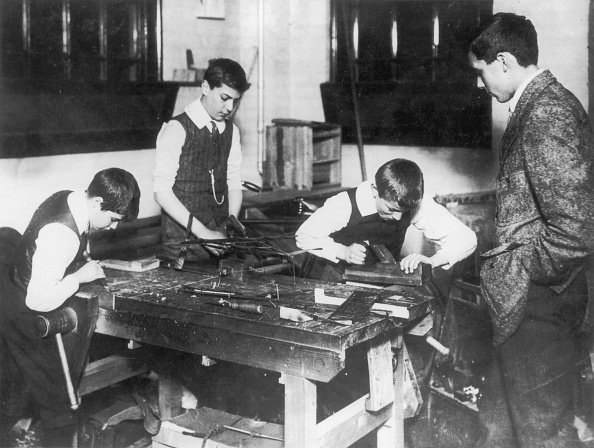
Schoolboys in a woodwork class circa 1915, FPG and Hulton Archive - Getty Images 2024
The year is 1843. Horace Mann, the fiery Secretary of the Massachusetts Board of Education, an abolitionist and leading voice in the nascent Common School Movement, stepped onto American soil after returning from Europe. He was particularly captivated by the highly organized, state-run school system of Prussia. What he brought back was a template for what he thought America’s young, diverse, and rapidly industrializing society urgently needed: a standardized, universal, and publicly-funded education system.
Before Mann’s trip to Prussia, the precursor to American public education was a highly fragmented system, characterized (largely) by one-room schoolhouses that taught an uncertain, disparately paced mix of arithmetic and grammar. The wealthy of the Northeast, knowing the poor outcomes of the schoolhouse system, would exclusively place their children in a small number of private boarding schools — the likes of Andover, Milton and Deerfield Academy. These schools would later come to be known as ‘The Group of Seven’.
Mann encountered in Prussia a system that, although flawed in various ways, served the wealthy and commoners alike. He envisioned an American counterpart that could do the same: provide similarly qualified, high-quality schools across intrinsically different communities. These schools could be beacons of opportunity and social mobility. He dedicated the remainder of his life to actualizing that mission, and successfully standardized the first modern public education system in the nation.
“Education, then, beyond all other devices of human origin, is the great equalizer of the conditions of men, — the balance-wheel of the social machinery.” - Horace Mann
Nearly two centuries later, the basic ideals behind Mann’s vision have fallen under attack. Local budgets continue to make up a larger and larger component of public school funding, redefining school quality as a correlate of zip code property value. Detractors of public education seek to privatize public schools and deputize third-party actors as outsourced management for a relatively new type of school: the charter school. And, just as charter schools relegate education to the outsourcing economy, vouchers eat up at school budgets, pushing students to leave the public system entirely.
Since the day billionaire businesswoman Betsy DeVos — the sister of military outsourcing tycoon Dick DeVos — took office as Secretary of Education initially in 2017, she has made her mission removing the public from public education through outsourcing education to private operators. Now, eight years after her swearing in, billionaire wrestling tycoon Linda McMahon sits in that seat with the same vision of privatized education, all the while publicly declaring she believes her role and department shouldn’t even exist.
The reality is a disheartening one.
While the federal government plays a minor supplementary role, the vast majority of public education funding is drawn from state and local sources. Critically, approximately 44.8% of this total funding, according to the most recent comprehensive data from the National Center for Education Statistics, stems from local sources, predominantly property taxes. This mechanism inherently and unjustly ties the quality of a classroom's resources to the taxable wealth of its immediate community.
The resulting resource disparities are severe and systematically concentrated. In a 1996 analysis, school districts serving the nation’s poorest communities spent, on average, $4,375 per student, while those serving the richest communities spent $6,827 per student. This gap of nearly $2,500 per pupil has only grown drastically since. In 2019, higher-poverty districts spent $4,000 less per student than the established threshold, a stark contrast to lower-poverty districts, which spent $5,700 more per student.
The ultimate tragedy is that a system conceived to be the great equalizer — a beacon of social mobility for a diverse, modern society — has been structurally corrupted into a mechanism of stratification, the exact antithesis of its founding purpose. Where Horace Mann envisioned qualified, high-quality schools for the wealthy and commoners alike, we now have a public system that mirrors and reinforces the private, zip-code apartheid that existed before his reforms.
On the right and left alike, many policymakers have abandoned the common sense vision of education as the uplifting equalizer that empowers every American to actualize their dreams. Until that vision is restored, and until the day when those who seek to decimate and divide our learning are ignored, we’re bound to become more polarized and divided along the lines of class and race than ever before.
